
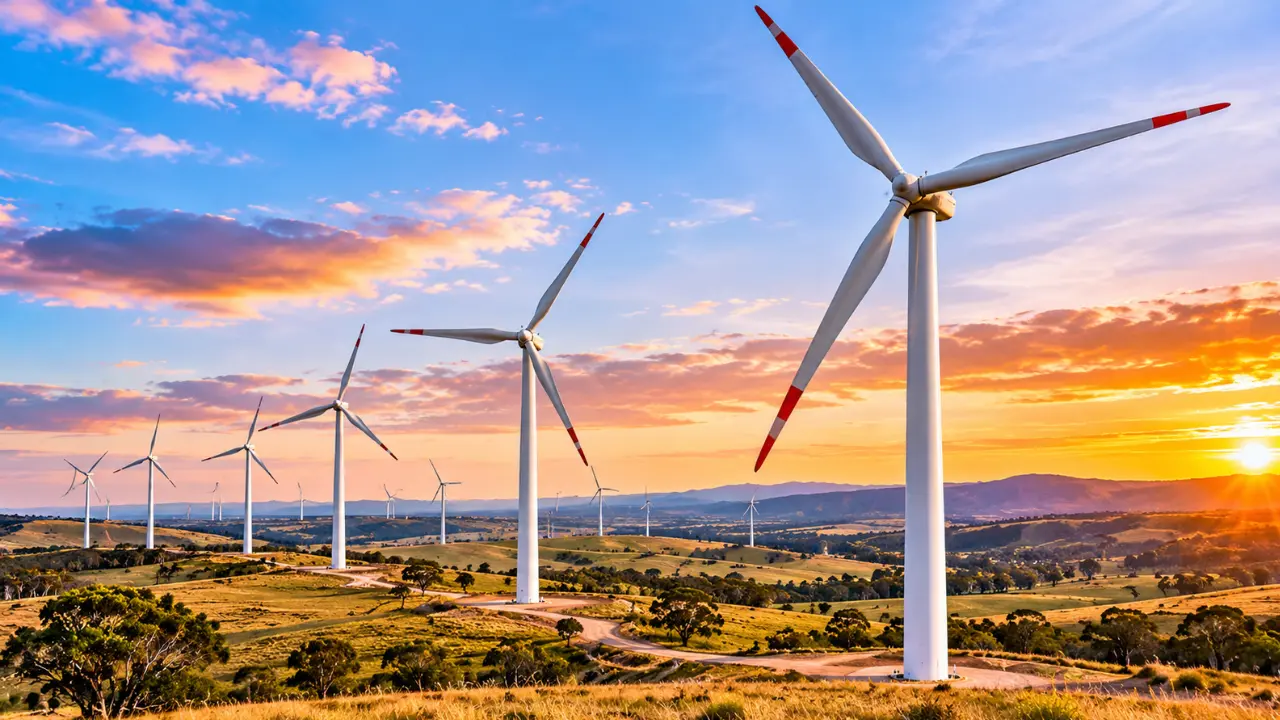

Australia’s wind power ambitions are getting bigger, quite literally. Tilt Renewables is considering turbines of around 9.5 megawatts (MW) each for its planned Nonowie wind farm near Whyalla, South Australia’s well-known steel city. If it goes ahead, these would be the most powerful wind turbines ever used in the country. Here’s what’s planned and why it matters.
What Is the Nonowie Wind Farm?
Nonowie is a proposed 1.2 gigawatt (GW) wind farm, located from around 10 kilometres west of Whyalla.
Tilt Renewables, one of Australia’s leading wind developers, is currently seeking planning approval for the project.
To put the size in perspective, 1.2 GW equals 1,200 MW. That would make Nonowie one of the largest wind projects proposed in Australia.
Fewer Turbines, Same Power
In a recent letter to local stakeholders, Tilt revealed it has cut the number of planned turbines from 148 to 126.
Despite using fewer machines, the project is still aiming for the same total capacity. That points to each turbine producing roughly 9.5 MW.
Tilt is understood to be talking with several equipment suppliers about which turbines to use, so the final model hasn’t been confirmed yet.
How These Turbines Compare
Wind turbines in Australia have grown rapidly in size and power over the past two decades. Early wind farms used machines of under 1 MW each, while today’s newest projects are using turbines several times more powerful.
| Project | Location | Turbine Size |
|---|---|---|
| Palmer and Waddi wind farms (Tilt) | SA and WA | 7.2 MW (Vestas) |
| Nullagine (Fortescue) and Narrogin (Neoen) | WA | 7.8 MW (Envision) |
| Nonowie (Tilt, proposed) | Near Whyalla, SA | Around 9.5 MW |
The Fortescue turbines are set to be the tallest in the country, reaching a tip height of about 280 metres thanks to special self-lifting frames. Tilt is considering a maximum tip height of around 250 metres at Nonowie.
Giant Batteries to Back It Up
Wind doesn’t blow all the time, so storage is a big part of the plan.
Tilt is proposing two separate eight-hour batteries, with a combined size of 600 MW and 4,800 megawatt-hours (MWh). If built today, that would be the largest battery system in Australia.
These batteries can store extra wind power when it’s plentiful and release it later when demand is high or the wind drops.
Protecting the Local Environment
Tilt says the reduced turbine count, along with new locations for the battery and substation, are designed to lower the project’s environmental impact.
The changes include bigger buffer zones around wedge-tailed eagle nests, sandalwood trees and the Cowleds Landing Sanctuary Zone.
The developer hopes to connect to ElectraNet’s main transmission line. If an upgraded line isn’t ready in time, Tilt says it would build its own 25 km, 275 kV line to the Cultana substation.
Why Whyalla Matters
The region west of Whyalla has become a major focus for South Australia’s clean energy plans.
The state government recently released land that could host around 13 GW of new wind and solar projects in the area. South Australia already runs on an average of about 75% renewable energy and is aiming for 100% “net” renewables, though that target may be reached a year later than its original 2027 goal.
Cheap, clean power could also help attract new industries to the region, including greener steelmaking.
Frequently Asked Questions
What is a 9.5 MW wind turbine?
It’s a turbine that can generate up to 9.5 megawatts of electricity at full power, more than any turbine currently operating in Australia.
Where is the Nonowie wind farm?
It’s planned from around 10 km west of Whyalla in South Australia.
How big is the Nonowie project?
It’s a proposed 1.2 GW wind farm with up to 126 turbines and two large eight-hour batteries.
Has the project been approved?
Not yet. Tilt Renewables is still seeking planning approval.
Conclusion
The Nonowie wind farm shows how quickly wind technology is advancing. Bigger turbines mean more power from fewer machines, while giant batteries help keep electricity flowing when the wind drops. If approved, the project could make Whyalla a key hub in Australia’s clean energy future, and a symbol of how a steel city can power up with renewables.
