
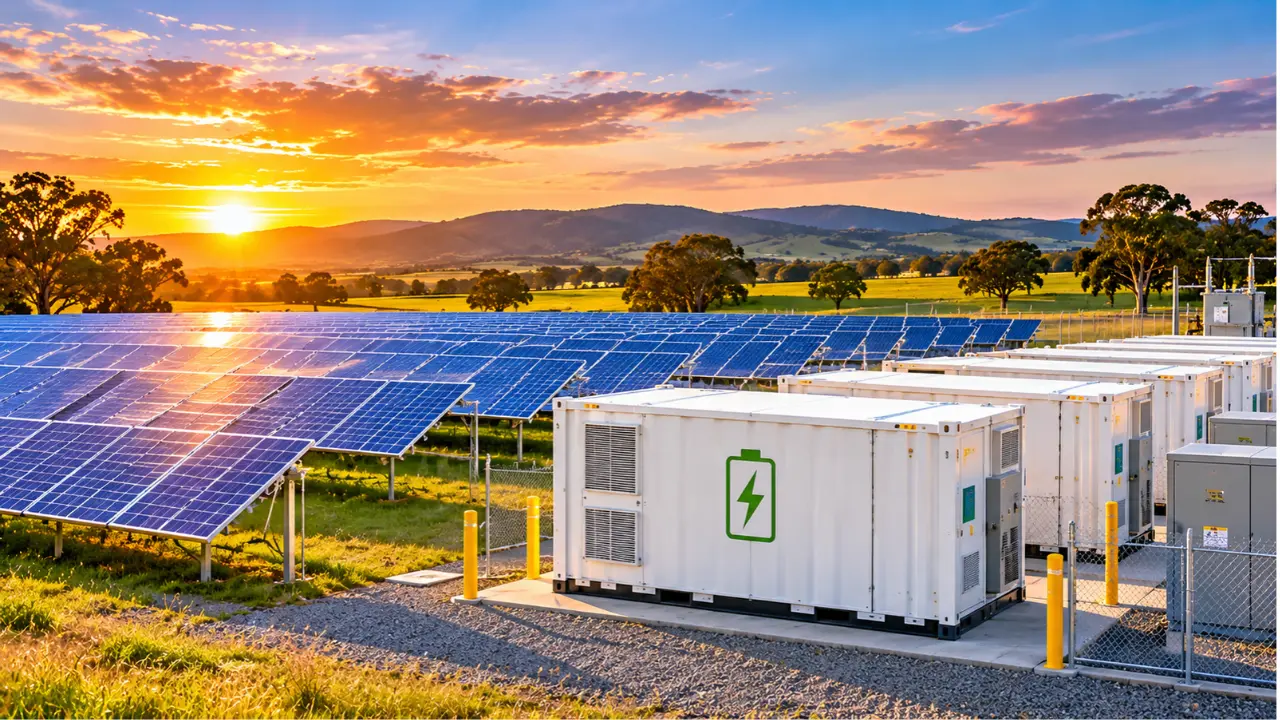
Victoria’s government-owned energy company, the State Electricity Commission (SEC), has signed a new 10-year deal that will add a big battery to an existing solar farm. It’s the SEC’s first “hybridisation” deal, meaning solar power and battery storage will now work together at one site. Here’s what the agreement means and why it’s a big step for clean energy in Victoria.
What Has the SEC Agreed To?
The SEC has signed a new 10-year offtake agreement with Pacific Partnerships, the renewable energy arm of construction group Cimic.
The deal covers the Glenrowan Solar Farm in north-east Victoria, plus a planned battery to be built on the same site. It replaces the SEC’s earlier agreement, which covered the solar farm alone.
An offtake agreement simply means the SEC commits to buying a share of the energy the project produces. That long-term certainty helps developers secure funding and move ahead with construction.
About the Glenrowan Solar Farm
The Glenrowan Solar Farm sits near the town of Glenrowan in Victoria’s north-east. It’s rated at around 102 MW, though some reports describe it as a 130 MW facility depending on how capacity is measured.
The project won support through the Victorian Renewable Energy Target (VRET) auction and began operating in May 2024.
It was the first of the projects selected in that auction round to start generating renewable power for Victoria.
The New Battery: What’s Planned
The new battery, known as the Chivers Road battery project, will be built on the solar farm site.
It’s designed as a 102 MW, four-hour battery, which means it can store up to 408 megawatt-hours (MWh) of energy. Under the deal, the SEC will have access to 65% of the battery’s output.
The battery already has approval for installation, and the new contract gives Pacific Partnerships the backing it needs to push the project towards construction.
Why Pairing Solar With Batteries Matters
Solar farms produce the most power in the middle of the day, often when demand is lower. Then, as the sun sets and people get home, demand rises just as solar output drops.
A battery solves this problem. It stores extra solar energy during the day and releases it in the evening peak.
This makes renewable energy more reliable, helps balance the grid and can reduce the need for gas or coal power at busy times. Adding a battery to an existing solar farm also makes good use of land and grid connections that are already in place.
The SEC’s Bigger Role in Victoria
The SEC was revived as a government-owned energy company to help speed up Victoria’s shift to renewable energy.
It currently supplies renewable electricity, backed by storage, to more than 4,400 sites across Victoria. That covers around 5% of the state’s total electricity demand.
The SEC is also building its own projects, including a fully publicly owned solar and battery park near Horsham, expected to be fully operating in 2027.
Frequently Asked Questions
What is a solar-battery hybrid?
It’s a project that combines a solar farm with a battery at the same site, so solar energy can be stored and used later.
What is the SEC in Victoria?
The State Electricity Commission is a Victorian government-owned energy company that invests in and supplies renewable energy.
How big is the Glenrowan battery?
It’s planned as a 102 MW, four-hour battery with up to 408 MWh of storage.
Why is this deal important?
It’s the SEC’s first hybridisation deal, and it gives the developer the long-term certainty needed to build the battery.
Conclusion
The SEC’s new 10-year contract for Glenrowan shows where Victoria’s energy future is heading: solar and storage working side by side. By backing a battery at an existing solar farm, the SEC is helping turn daytime sunshine into reliable power for the evening peak. It’s a practical step towards a cleaner, steadier and more affordable grid for Victorians.
