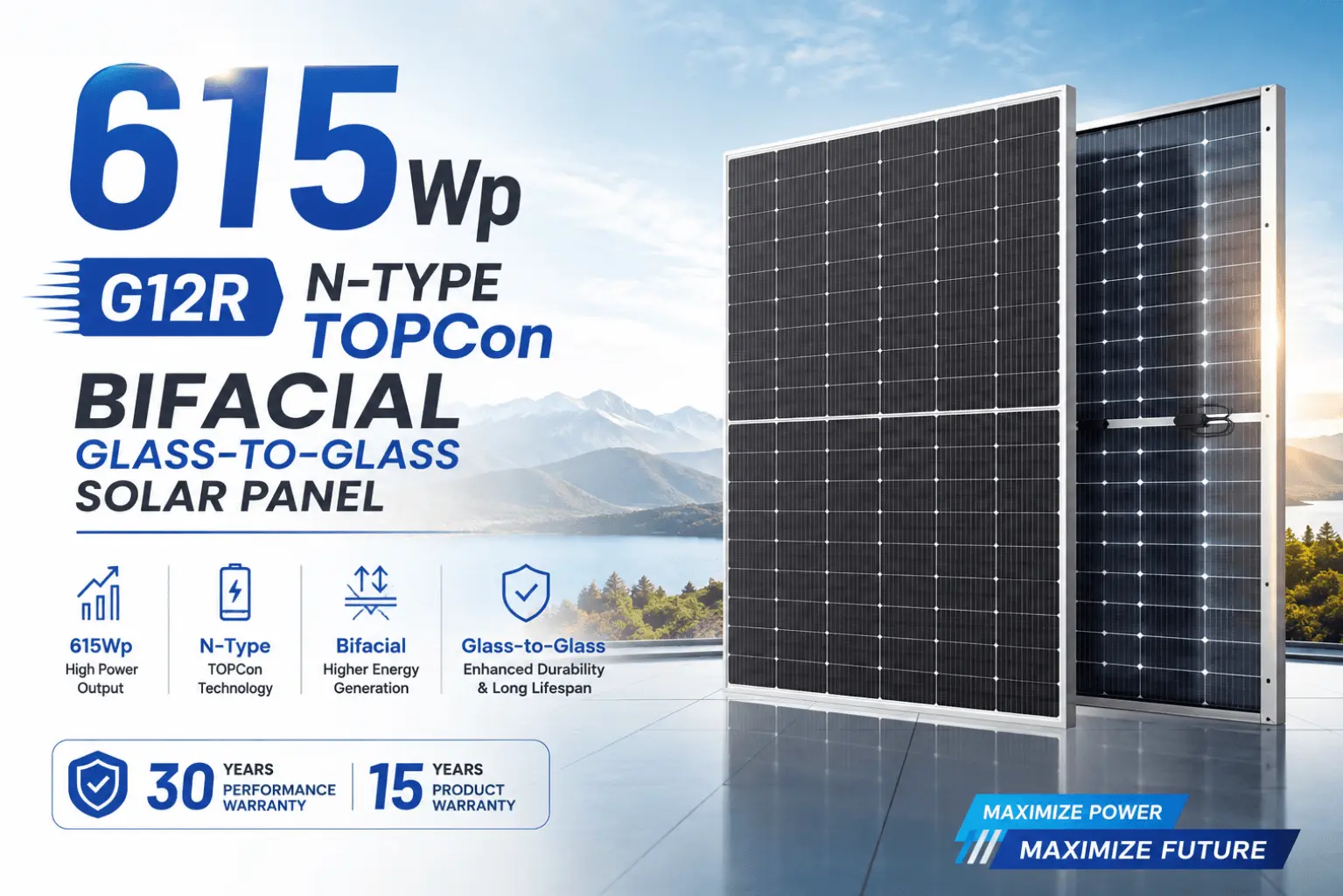
Walk through a commercial solar installer’s catalog right now and you’ll notice a lot of panels clustered around the 600 to 640Wp range, built on the larger G12R wafer format. The 615Wp G12R N-Type TOPCon Bifacial Glass-to-Glass panel is a solid example of that category, currently offered by several manufacturers including Waaree, Adani, Saatvik, and GCL Solar, each with slightly different specs but the same core formula: bigger cells, dual-sided glass, and N-type technology squeezed into a single module. The appeal isn’t just the wattage number, it’s that fewer panels can deliver the same total output, which matters a lot once you’re paying for racking, wiring, and labor on a large installation.
What “G12R” and “N-Type TOPCon” Actually Mean
The naming on these panels sounds technical, but it breaks down simply. G12R refers to the wafer size, a larger rectangular silicon wafer format that lets manufacturers fit more cell area into each panel without dramatically increasing its footprint. TOPCon stands for Tunnel Oxide Passivated Contact, an N-type cell technology that’s steadily replacing older P-type PERC cells across the industry because it captures more sunlight and loses less energy to heat. Across manufacturers, panels in this category typically land around 22.5 to 23.25% efficiency, with a lower temperature coefficient than P-type panels, generally around -0.30%/°C versus -0.36%/°C, meaning they hold up better in hot climates where panel performance often sags in the afternoon sun.
The Bifacial, Glass-to-Glass Build
The other half of the name matters just as much. Bifacial means the panel captures light on both the front and back sides, not just the front, generating extra power when sunlight reflects off the ground, a rooftop, or a light-colored surface underneath. Manufacturers commonly advertise 10 to 30% additional power gain from bifacial designs compared to standard one-sided modules, though real-world gains depend heavily on mounting height and surface reflectivity. Pairing that with a glass-to-glass, or dual-glass, construction instead of a traditional glass-and-backsheet design adds durability and helps the panel resist moisture ingress and potential-induced degradation, or PID, over its lifespan, which is part of why these panels tend to carry longer warranties than older panel designs.
Built to Handle Rough Conditions
Panels in this category are generally engineered with a fairly demanding environment in mind. Most carry an IP68-rated junction box with multiple bypass diodes for electrical safety, an operating temperature range stretching from around -40°C to 85°C, and anti-LID and anti-PID technology to reduce the gradual power loss that panels experience over decades of sun exposure. First-year degradation is typically kept under 1%, with subsequent annual degradation often below 0.4%, which is a meaningful improvement over solar technology from even five or six years ago. That combination of resilience and low degradation is a big part of why performance warranties in this category commonly run 25 to 30 years.
Where These Panels Actually Get Used
Because of their size and output, G12R TOPCon bifacial panels are most commonly used in commercial, industrial, and utility-scale installations rather than small residential rooftops, though larger homes with adequate roof space are increasingly using them too. Their higher power density means fewer panels are needed to hit a given system size, which reduces mounting hardware, wiring complexity, and labor costs on larger projects. Bifacial performance also shines brightest in ground-mounted systems, elevated racking, and carports, settings with open space and a reflective surface beneath the panel, rather than tightly packed residential roofs where the backside has nowhere to catch reflected light.
Quick Facts at a Glance
Typical specifications for panels in this 615Wp G12R TOPCon bifacial category
| Detail | Information |
|---|---|
| Rated power | 615Wp |
| Wafer format | G12R |
| Cell technology | N-Type TOPCon |
| Cell count | 132 or 144 half-cut cells (varies by manufacturer) |
| Construction | Bifacial, glass-to-glass (dual glass) |
| Typical efficiency | ~22.5% – 23.25% |
| Bifaciality factor | ~75–85% |
| Additional power gain (bifacial) | Up to 10–30% vs. P-type/monofacial |
| Temperature coefficient (Pmax) | ~-0.30%/°C |
| Operating temperature range | -40°C to +85°C |
| First-year degradation | <1% |
| Annual degradation (year 2+) | <0.30–0.40% |
| Junction box rating | IP68, multiple bypass diodes |
| Connector type | MC4-compatible |
| Typical product warranty | 12–15 years |
| Typical performance warranty | 25–30 years |
| Common certifications | IEC 61215, IEC 61730, UL 61730, IEC 61701 |
| Best-suited installations | Commercial, industrial, utility-scale, ground-mount |
Frequently Asked Questions
Common questions about G12R TOPCon bifacial panels
What does “bifacial” actually add in real-world use?
It lets the panel generate power from reflected light hitting its backside, not just direct sunlight on the front. Manufacturers commonly claim 10–30% extra energy yield, though actual gains depend on mounting height and how reflective the surface underneath is.
Is N-Type TOPCon better than older P-type PERC panels?
Generally, yes. TOPCon panels tend to run more efficient, degrade more slowly over time, and perform better in high heat thanks to a lower temperature coefficient, which is why the industry has been shifting toward N-type technology.
Can this panel be used on a residential roof?
It can, especially on larger homes with ample roof space, but its size and output profile make it more common in commercial and utility-scale projects, where fewer panels covering more wattage saves on installation costs.
What does “glass-to-glass” construction mean for durability?
Instead of a traditional backsheet, the panel is sandwiched between two layers of tempered glass, which generally improves resistance to moisture, micro-cracks, and potential-induced degradation, contributing to longer warranty periods.
How long do these panels typically last?
Most carry a 25 to 30-year performance warranty, with degradation rates designed to stay under roughly 1% in the first year and under 0.4% annually after that.
Does the wattage vary between manufacturers?
Yes. While 615Wp is common, several manufacturers offer closely related versions in the 610–640Wp range using the same G12R wafer and TOPCon bifacial design, so it’s worth comparing datasheets rather than assuming all “615Wp G12R” panels are identical.